


Restoring Confidence Amidst Chronic Illness: Clarissa LePage’s CEI Story
April 29, 2026
Clarissa was fourteen years old when she got her gallbladder removed. Unfortunately, the surgery also caused stomach paralysis, a chronic illness that she still manages today.
While in high school, Clarissa faced several obstacles to completing coursework while managing her condition. Thankfully, she found an alternative path to success and a new support system at her local community college in Idaho Falls.
Overcoming barriers to high school graduation
After her operation, Clarissa was homebound for most of her freshman year. Due to the side effects of not being able to properly digest food, she also missed half of her sophomore and junior years. She would often wake up too sick to go to school.
Clarissa struggled to navigate her illness in a public school, a charter school, and even summer school. None of these avenues offered her sufficient accommodations to allow her to finish high school and graduate with her peers.
“Our school systems aren't really set up for helping kids with medical conditions that are preventing them from attending school,” she said.
“When you have so much failure shoved in your face, and it's not entirely your fault, it's the worst. It wears a person down quicker than anything else.”
The only option that offered her the flexibility she needed was the GED program at Eastern Idaho Technical College (now College of Eastern Idaho). Since students in Idaho can’t be enrolled in high school while pursuing a GED, Clarissa had to make the difficult decision to drop out to earn her diploma.
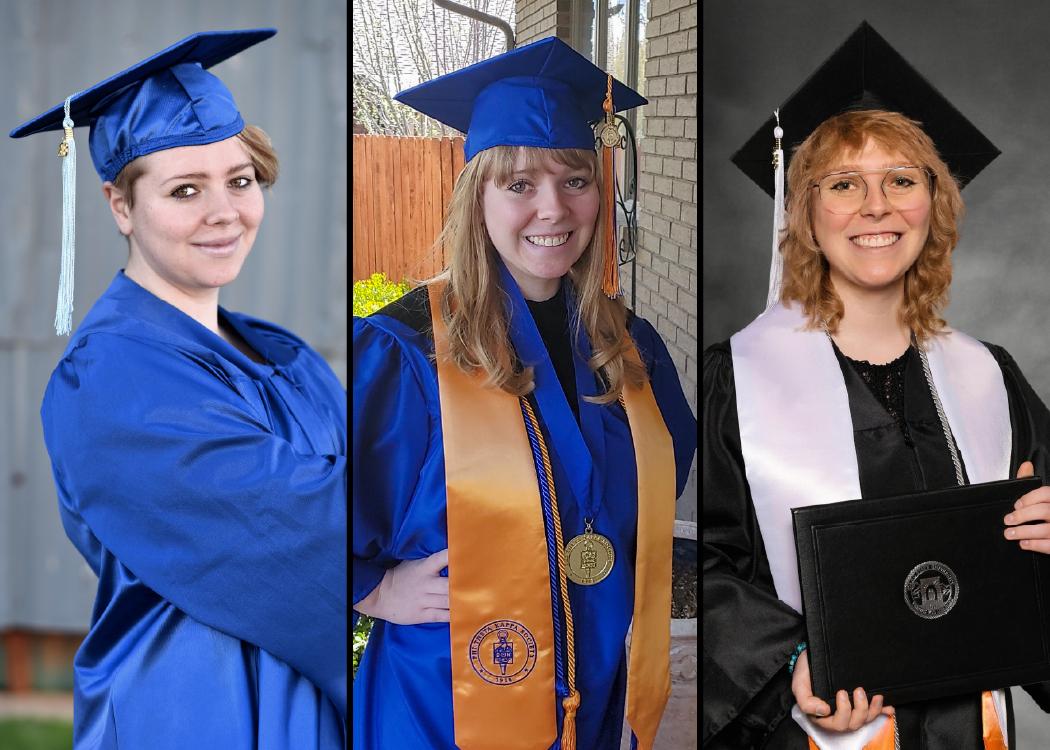
Within a month (and months ahead of her high school friends), Clarissa passed the GED exams. To celebrate her achievement, she got approval to walk across the stage with CEI’s first graduating class in spring 2018.
“I still got to walk even though it wasn't with my peers or at high school,” Clarissa said. “That was important to me, and I'm more than grateful for it.”
Clarissa would go on to graduate from CEI’s Associate of Arts program in 2022. At CEI, she was in the top 10% of her class and was inducted into the National Honor Society. In 2025, she completed her bachelor’s degree in English at Idaho State University (ISU).
Her story is just one example of a student managing chronic illness while striving to achieve her educational goals. According to the National Survey of Children’s Health, over 10% of children in the U.S. have a chronic condition that requires “elevated medical, mental, or educational services.” The Pew Research Center found that 16% of college-aged adults in the U.S. have at least one chronic condition, and 4% have two or more.
For these learners, community college programs and resources can remove barriers to educational opportunities and keep them on track to a successful career and fulfilling life.
But it wasn’t just the programs that helped Clarissa succeed. It was the people who believed in her.
The people behind the CEI programs
At CEI, Clarissa interacted with faculty and staff who pushed her to meet her full potential. When she began the GED program, a staff member reminded her that she was a straight-A student before she got sick. She saw Clarissa’s talent for writing and waived the fee for the Reasoning Through Language Arts GED exam.
Then, in one of Clarissa’s first classes for her associate degree, an instructor went out of her way to refer her to the Student Ambassadors program and write a letter of recommendation for her application.
Clarissa applied and got accepted to the program. As an ambassador, she received free tuition at CEI, and met another mentor, Connor Sorensen, now the associate director of academic support at the College.
“If I came in high-strung from whatever class I had just gotten out of, or whatever assignment I was panicking over, Connor was like, ‘You'll do fine, it'll be fine,’” she said. “And I needed that grounding because I did panic about a decent chunk of my assignments.”
Clarissa still remembers many of her CEI instructors. Her speech instructor would often hold conversations in the hallway, even after she had graduated from his course. Ken Kisner, the department chair of business, taught a fun and engaging history class that she still remembers. LJ Krumenacker, a geology adjunct instructor, helped her get a job counting bones at ISU’s Museum of Natural History.
“Realistically, every single instructor I had at CEI has been wonderful,” she said. Clarissa’s support system at CEI helped her gain the confidence she needed to carve her own path to success.
“Getting my degree was something that seemed unattainable during high school, because I was sick all the time. But all of the instructors and staff have just been so patient and understanding about more things than just my physical health. That patience allowed me the time to figure out how to develop the skills to manage schoolwork around my medical condition.”
Image Caption: Clarissa’s GED graduation, CEI graduation, and ISU graduation (in that order).